
QR codes on

Clothes

Printed or woven into fabric that stretches, folds, and gets washed — a surface paper was never built for.

A shopper with paper bags holding up a printed QR code card.

Best QR type for this

Product

A garment tag has almost no room for anything beyond a size and a care symbol, so a Product type gives a code somewhere to send material sourcing, styling suggestions, or a care guide that the tag itself was never going to fit. It's also a natural fit for reorder or restock links tied to that exact item.

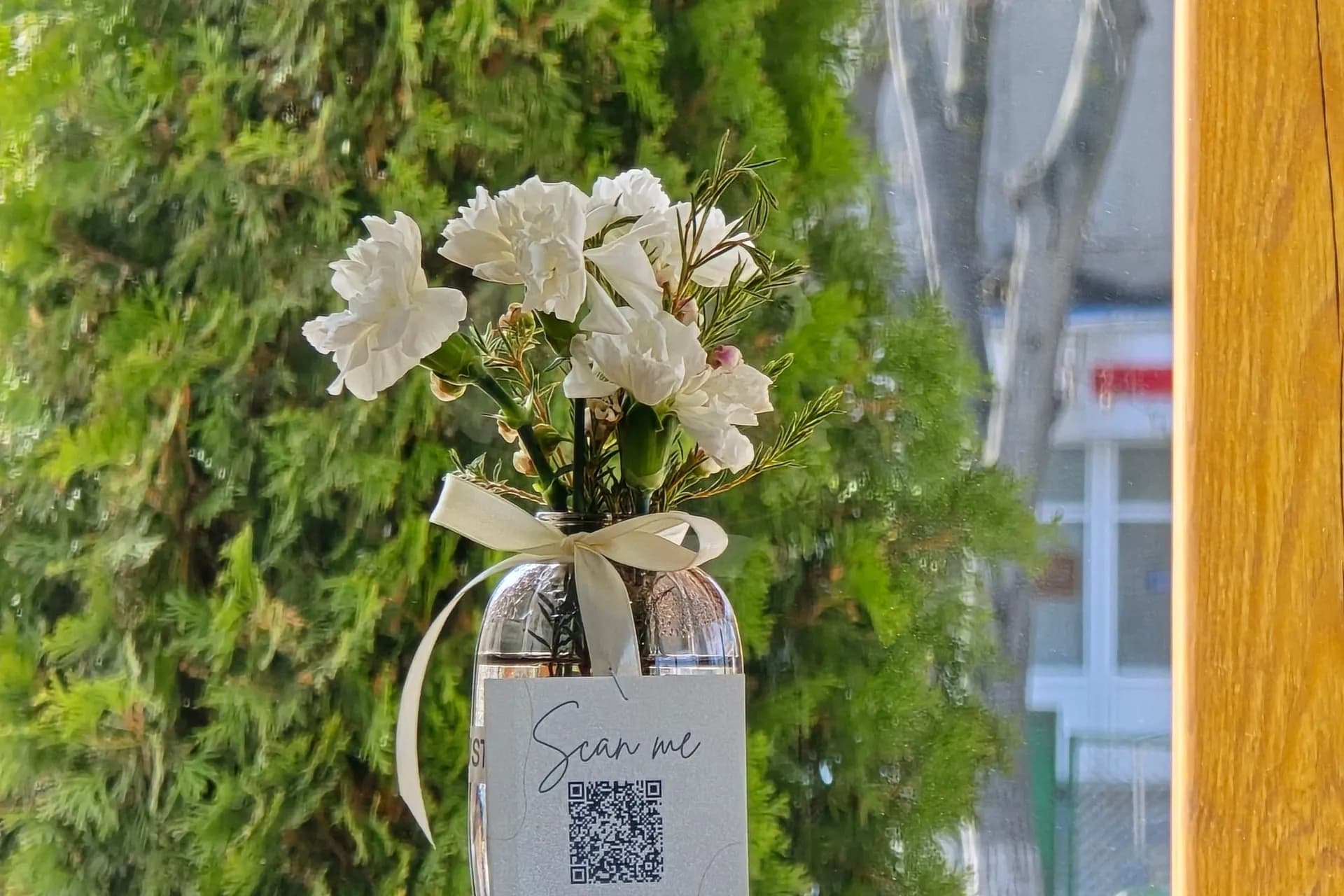
A glass vase of white flowers with a "scan me" QR code tag.

Design considerations for print

Dynamic vs. static, for clothes

Dynamic, for the same reason most product-linked codes are: care instructions, sourcing claims, and sizing guidance occasionally get updated between production runs of what's nominally the 'same' garment, and a static code sewn into thousands of already-shipped units can't be corrected once it's out the door. A dynamic code lets a brand update the destination — a corrected care guide, updated material sourcing, a seasonal restock link — without it mattering how many garments with that tag are already on hangers or in someone's closet.

A worked example

At a 25cm reading distance, the 10:1 rule needs a 2.5cm floor — 16–20mm covers that on a stable woven tag, where the fabric holds still and the print sits on a small, flat, dedicated surface with no stretch to account for. Move the code onto the garment itself, printed directly on fabric that flexes with the body, and the same math no longer accounts for the actual failure mode on this surface — which has much less to do with distance than with what the fabric does to the print over time.

Fabric texture, stretch, and the wash cycle

Every other surface in this guide is either rigid or, at worst, gets folded once along a predictable crease. Clothing does something print material almost never has to survive: it moves with a body, stretches unevenly across different areas depending on fit and fabric, and then gets washed and dried repeatedly over a lifespan that can run into years. None of those are conditions a QR code's underlying design was built around, and printing directly onto fabric — as opposed to a stable woven or printed tag — inherits all three problems at once.

Texture is the first issue, and it's there from the moment of printing, before any wear or washing happens at all. A tightly woven, smooth fabric behaves reasonably close to paper — ink sits on a fairly even surface and holds a crisp edge. A textured knit or a fabric with visible weave doesn't offer that same even surface; the weave itself creates tiny gaps and raised threads that interrupt a module's clean edge independent of how good the printing process is. A code that would look perfectly crisp printed on a smooth tag can look genuinely rougher printed directly onto a heavier knit, purely because of what the fabric's surface is doing underneath the ink.

Stretch compounds this over time. Fabric printed in a flat, relaxed state distorts when the garment is worn and the fabric stretches with the body — a code placed across a high-stretch zone (a fitted area, a stretchy side panel) can warp slightly every time it's worn, which is a kind of repeated, reversible distortion that rigid print material never experiences. And then there's washing, which is the most destructive factor of the three: heat, agitation, and detergent chemically and physically wear at printed ink over dozens of cycles in a way no other surface in this guide has to plan for. A code that passes every test straight off the production line can degrade measurably after a garment's first several washes — which is exactly why wash-cycle testing, not just initial print-quality testing, has to be part of approving any code meant to go directly on fabric rather than on a dedicated tag.

Common mistakes

How to do it

  1. 1

    Choose tag or direct-print

    A woven or printed tag holds detail better than fabric printed directly — pick based on how much durability the placement really needs.

  2. 2

    Pick a low-stretch zone

    Avoid seams, hems under tension, and heavily flexed areas if printing directly on the garment.

  3. 3

    Wash-test before approving

    Run a real sample through several wash-and-dry cycles and rescan before signing off on a full production run.

Frequently asked

How big should a QR code be on a clothing tag?
16–20mm on a woven or printed tag is enough for close-up reading at 20–30cm. If the code is printed directly on the fabric instead, size up to 30mm or more to compensate for the surface's lower detail retention.
Does washing damage a QR code printed on fabric?
It can — repeated wash and dry cycles are the main real-world stress a clothing code faces, and a code that scans fine straight off production needs to be re-tested after several wash cycles before it's trusted for a full run.
Where's the best place for a QR code on clothing?
A woven or printed tag, or a low-stretch, reinforced area of the fabric if printed directly on the garment — never across a seam, hem, or a zone that flexes heavily with normal movement.
Should a clothing QR code be static or dynamic?
Dynamic. Care instructions, sourcing details, and restock links can change after a garment run has already shipped, and a static code sewn into thousands of units can't be corrected retroactively.

Related materials

Relevant QR types

Ready to print one?

Free to generate, free to download.

Create your Product QR code