
A worked example
At 35cm, the 10:1 rule needs a 3.5cm floor — 20–25mm covers that comfortably for an item examined at arm's length, the way most promotional merchandise actually gets handled. That number is a fine starting point on paper; on this surface it's only half the picture, because the production method matters as much as the distance math.
What pad printing and engraving can't hold onto
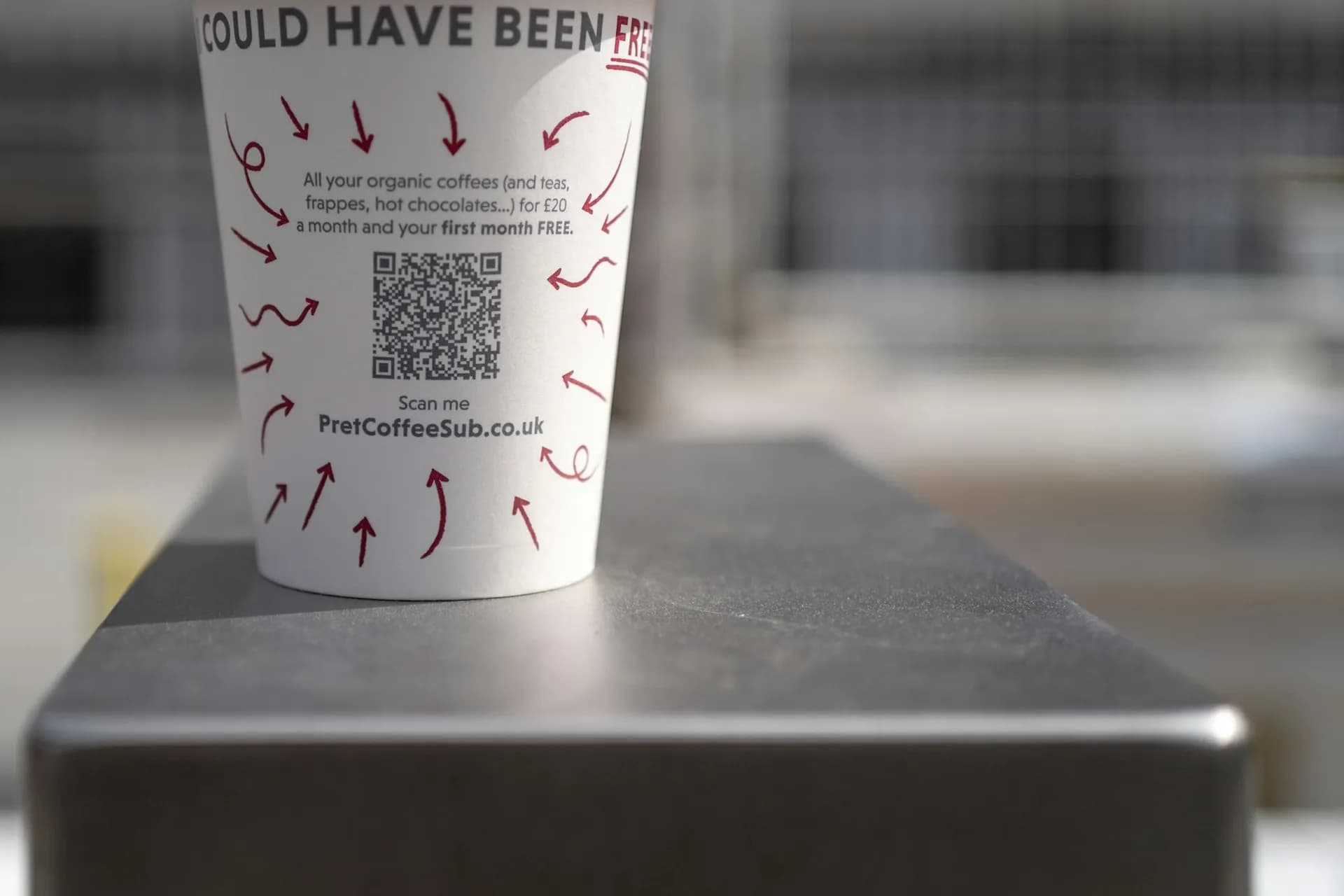
Nearly every print-size guide, including most of this one, treats production method as a constant — assume competent offset or digital printing on paper, and the 10:1 distance rule does the rest of the work. Promotional merchandise breaks that assumption more thoroughly than almost any other surface in this guide, because very little of it is actually printed the way paper is. Mugs and hard plastic items are typically pad printed, a process that transfers ink via a soft silicone pad and simply doesn't hold the same fine resolution a digital or offset press does. Metal items are often laser engraved, which removes material rather than depositing ink and has its own resolution ceiling tied to the engraving equipment. Apparel-adjacent giveaways are frequently embroidered, where the "resolution" is limited by individual stitch width — often several times coarser than even a pad-printed dot.
Each of these methods was developed to put a logo or a few words of text onto an object, not to reproduce the kind of fine, high-frequency detail a QR code's module grid requires. A code that would look crisp printed on paper at 20mm can render as a blurred, merged mass of ink or an incomplete stitch pattern at the identical size on a pad-printed mug, simply because the production method physically cannot resolve modules that small or that close together. This isn't a quality-control failure in the traditional sense — the printer or engraver is operating within its normal tolerances — it's a mismatch between a code designed for one production method and manufactured with a different one.
The fix has two parts. First, size up beyond what the distance math alone suggests, giving each module more physical room to render cleanly even at the production method's coarser resolution. Second, and more reliably, request an actual physical sample from the real production run — not a rendered mockup — before approving a full order. A mockup image shows what the design intends; only a physical sample shows what the pad printer, laser, or embroidery machine actually produces, and that gap is exactly where an untested giveaway code fails.